
Boolean algebra plays a critical role in various fields, especially in digital electronics and computer science. Its foundational principles guide how data is manipulated and processed in binary form, making it essential for anyone working in these domains.
In this article, we’ll explore the purpose and applications of Boolean algebra, touching on its key operations, laws, and its significance in the modern technological landscape.
The Origins and History of Boolean Algebra
Boolean algebra was developed in the 19th century by mathematician George Boole. His work laid the groundwork for the logical operations that are integral to computer science and digital electronics today. Boole’s primary aim was to create a method for representing logical statements in a mathematical form.
Before the advent of Boolean algebra, the field of logic was primarily theoretical. Boolean algebra introduced a way to formalize logical expressions and solve complex problems using a systematic approach. This revolutionary concept is foundational to binary systems, which underlie nearly every modern technological advancement, including computers and mobile phones.
With Boolean algebra, we now have a standardized way of expressing and manipulating true/false, or 1/0, values. This dual-state system has proven to be extremely versatile, allowing complex data structures and algorithms to be built upon simple principles. A truth table generator can be used to visualize Boolean logic, enhancing understanding and application.
Key Operations in Boolean Algebra
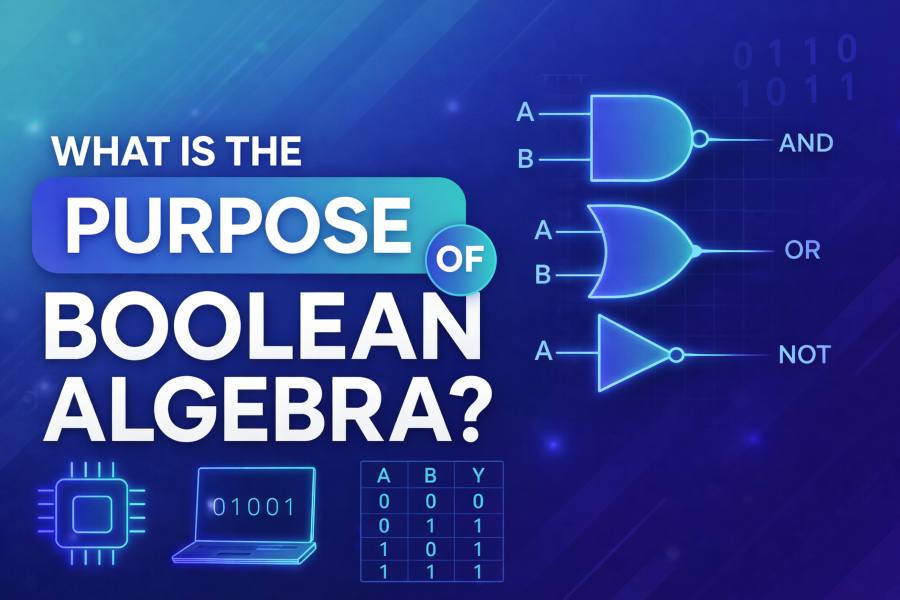
In Boolean algebra, the fundamental operations are AND, OR, and NOT, each serving a distinct purpose in manipulating binary values. The AND operation returns true if both operands are true, OR returns true if at least one operand is true, and NOT inverts the value of the operand.
These operations form the backbone of logical reasoning and decision-making processes in technology. By combining AND, OR, and NOT operations, more complex logic expressions are formed, which can represent intricate conditions in digital circuits. Understanding how to make a truth table helps visualize these operations, making it easier to grasp how they influence logic gates and decision trees.
AND Operation
The AND operation is used to find the intersection of two sets of data. In Boolean terms, it returns true (or 1) only when both operands are true. For example, if you have two conditions: “It is raining” and “I have an umbrella,” the AND operation will yield true only if both are true.
OR Operation
The OR operation, on the other hand, returns true when at least one of the conditions is true. Using the same example, if either “It is raining” or “I have an umbrella” is true, the OR operation will yield true. This operation is incredibly useful when dealing with multiple conditions that may not all need to be true.
NOT Operation
The NOT operation is a simple yet powerful tool that reverses the value of its operand. If the operand is true, the NOT operation returns false, and if the operand is false, it returns true. This operation is critical in creating negations within logical systems.
The Laws and Theorems of Boolean Algebra
Just as regular algebra has laws that govern the manipulation of numbers, Boolean algebra has its own set of laws. These include the Commutative, Associative, and Distributive laws, which provide structure and consistency in how logical operations are performed.
The Commutative Law states that the order of operands doesn’t affect the result, meaning that A AND B is the same as B AND A. The Associative Law allows for the grouping of operands to be rearranged, so (A AND B) AND C is the same as A AND (B AND C). The Distributive Law is akin to the distributive property in regular algebra, where A AND (B OR C) is equivalent to (A AND B) OR (A AND C).
These laws are crucial for simplifying Boolean expressions and designing digital circuits. Understanding these laws can make complex logical expressions easier to manage. For example, if you’re designing a circuit, simplifying expressions using these laws will result in fewer gates and less complex wiring. How to construct a truth table is a helpful resource for learning how to apply these laws and simplify Boolean expressions.
The Purpose of Boolean Algebra in Computer Science
In computer science, Boolean algebra is used extensively in algorithms and data structures, particularly in the creation of decision-making processes. Boolean expressions serve as the foundation of control flow in computer programs, enabling the implementation of conditions and loops.
When writing code, Boolean logic is used to evaluate conditions, such as whether a file exists, whether a user is authorized to access a resource, or whether an item in a list meets certain criteria. This ability to represent complex decision-making in a binary format is vital to the functioning of modern software and systems.
Boolean algebra also plays a key role in search algorithms, network protocols, and database queries. The principles of Boolean logic are implemented in virtually every aspect of computer programming, from the simplest if-statements to more advanced machine learning models. What is a truth table in logic offers further insights into how Boolean algebra can be applied in these fields.
The Role of Boolean Algebra in Digital Electronics
Digital electronics rely heavily on Boolean algebra for designing circuits that perform specific tasks. Logic gates, the fundamental building blocks of digital circuits, are designed based on the principles of Boolean algebra. These gates perform operations such as AND, OR, and NOT on input signals to produce output signals that drive various devices and systems.
For example, an AND gate is used in a situation where multiple conditions must be true for an output to be true. An OR gate, on the other hand, is used when only one condition needs to be true for the output to be true. These logic gates form the basis of everything from calculators to smartphones and computers.
By understanding how to design and simplify circuits using Boolean algebra, engineers are able to create efficient and reliable systems that can handle complex tasks. Understanding these designs and logic circuits is essential for anyone pursuing a career in electrical engineering or digital system design.
Applications of Boolean Algebra Beyond Electronics
While Boolean algebra is most commonly associated with digital electronics, its applications extend far beyond that. One of the primary applications of Boolean algebra is in decision-making, where logical conditions are analyzed to arrive at conclusions.
In fields like artificial intelligence (AI) and machine learning, Boolean logic is used to model decision trees and neural networks, where nodes represent logical conditions, and the edges represent outcomes based on those conditions. Boolean algebra is also used in cryptography to secure information, as many encryption algorithms rely on complex logical operations to encode and decode data.
In data analysis, Boolean algebra is used in database queries to filter and retrieve specific information. By combining different logical operators, users can create complex queries that return the precise data they need.
Conclusion
Boolean algebra is a cornerstone of modern technology and an essential tool for anyone working in fields like computer science, digital electronics, and artificial intelligence. Its applications are vast, from the design of logic circuits to the creation of algorithms that power today’s software. With its well-established laws and operations, Boolean algebra remains an indispensable tool for simplifying complex problems and designing innovative solutions.
Whether you’re working on a new digital device, writing code, or analyzing data, understanding Boolean algebra will provide you with a solid foundation for solving logical problems efficiently and effectively.