
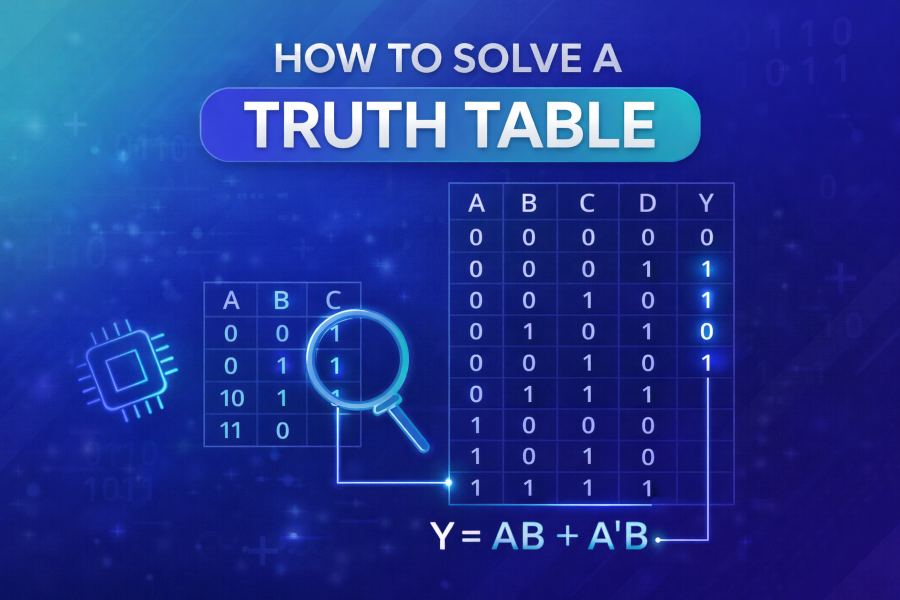
Creating and evaluating truth tables is an essential skill in logic and mathematics. These tables are a tool used to determine the truth value of logical expressions, making them indispensable in fields like computer science, philosophy, and artificial intelligence. By following a structured approach, you can learn how to solve truth tables for any logical formula or compound statement. This article will guide you through the entire process, breaking down each step and providing practical tips along the way.
Understanding the Basics of Truth Tables
To understand how to solve a truth table, you first need to grasp its basic components. A truth table is a table that shows all possible truth values of a set of logical statements. These statements are often connected by logical operators such as AND, OR, and NOT.
A truth table helps us evaluate compound statements by showing how the truth value of a complex expression depends on the truth values of its individual components. The number of rows in a truth table increases exponentially with the number of variables in the expression. For example, a table with two variables will have four rows, while three variables will have eight rows.
The process of solving a truth table involves:
- Identifying the logical operators in the expression
- Listing all possible combinations of truth values for the variables
- Evaluating the truth value of each operator in each row
- Analyzing the final outcome of the compound statement
By understanding these steps, you can construct and analyze truth tables for various logical expressions.
The Role of a Truth Table Generator
Creating truth tables by hand can be time-consuming and error-prone, especially with more complex logical statements. Fortunately, a truth table generator can automate this process, providing a quick and accurate solution. This tool allows you to input logical expressions and generates the corresponding truth table, saving you time and effort. The generator simplifies the process of determining truth values for complex logical statements, making it an indispensable resource for anyone working with logic.
Using a truth table generator is especially helpful for students and professionals who need to solve multiple truth tables or work with complex formulas. Instead of manually calculating each row and operator, the tool does the work for you, providing instant results. This ensures that you can focus more on understanding the logic behind the expressions rather than getting bogged down in the mechanics of table creation.
Step-by-Step Guide to Solving a Truth Table
Creating a truth table is a methodical process. Let’s break it down into manageable steps.
1. Identify the Variables and Operators
The first step in solving a truth table is identifying the variables and logical operators in the given expression. A variable can be any logical statement, typically denoted as letters like P, Q, or R. Logical operators are symbols that connect these variables and define the relationships between them. Common logical operators include:
- AND (∧): The result is true if both statements are true.
- OR (∨): The result is true if at least one statement is true.
- NOT (¬): The result is true if the statement is false.
2. List All Possible Truth Values for the Variables
Next, you will list all possible truth values for the variables. For n variables, there will be 2^n possible combinations of truth values. For example, for two variables (P and Q), the possible combinations are:
- P = true, Q = true
- P = true, Q = false
- P = false, Q = true
- P = false, Q = false
For each combination, you will evaluate the truth value of the logical operators.
3. Evaluate the Truth Values for Each Operator
Once you have the truth values for the variables, you will begin evaluating the logical operators. Start with the innermost operators and work your way outward. For example, if your expression is (P ∧ Q) ∨ R, you will first evaluate P ∧ Q, then apply the OR operation with R.
4. Analyze the Final Outcome
After evaluating all operators, analyze the final truth value of the compound statement. This is the value that you write in the last column of your truth table. The outcome will depend on the logical operators used in the expression.
How to Make a Truth Table
Making a truth table is a straightforward process once you understand the steps. To ensure that you are following the correct procedure, refer to this guide on how to make a truth table, which will walk you through the process in greater detail. The guide covers practical examples and tips to help you become proficient in creating truth tables for any logical expression.
By following the steps outlined in the guide, you can avoid common mistakes and build accurate truth tables every time. This resource is perfect for beginners and those looking to strengthen their understanding of truth tables.
Common Mistakes When Solving Truth Tables
When constructing truth tables, many people make mistakes due to the complexity of logical expressions. Some common errors include:
- Incorrectly evaluating operators: It’s easy to misinterpret the truth values of logical operators, especially when working with multiple variables.
- Overlooking parentheses: Parentheses dictate the order in which operators are evaluated, so failing to follow proper order can lead to incorrect results.
- Omitting possible combinations: For more complex expressions, it’s easy to forget to list all possible combinations of truth values for the variables.
To avoid these mistakes, always double-check your work and follow the steps methodically. With practice, you’ll be able to create truth tables more efficiently and accurately.
Advanced Techniques for Truth Tables
As you become more comfortable with solving truth tables, you may encounter more complex logical statements that require advanced techniques. One useful concept is logical equivalence, which involves determining whether two expressions always yield the same truth value. You can use truth tables to test logical equivalence by comparing the truth values of two expressions under all possible combinations of variables.
For example, the expressions (P ∧ Q) and (Q ∧ P) are logically equivalent because they yield the same truth values in all cases. By constructing truth tables for each expression, you can verify this equivalence.
Another advanced technique is determining the tautology or contradiction of a statement. A tautology is a statement that is always true, regardless of the truth values of its variables. A contradiction, on the other hand, is always false.
How to Construct a Truth Table for Compound Statements
When dealing with compound statements, the process of constructing a truth table becomes slightly more involved. A guide on how to construct a truth table provides detailed instructions on how to approach these types of problems. This guide will help you understand the importance of breaking down complex expressions into smaller parts and systematically evaluating each component.
By using this approach, you can solve even the most complicated logical formulas and ensure that your truth tables are accurate and complete.
Why Truth Tables Are Important in Logic and Computing
Truth tables play a crucial role in both logic and computing. In logic, they help us understand the relationships between different propositions and evaluate the validity of logical arguments. In computing, truth tables are used in digital circuits and boolean algebra to design and optimize circuits that perform logical operations.
For example, logic gates such as AND, OR, and NOT gates are the building blocks of digital circuits. These gates are implemented using truth tables to ensure that the circuits function as intended. Understanding how to create and analyze truth tables is essential for anyone studying computer science or electrical engineering.
Conclusion
Solving a truth table is a valuable skill that can be applied in various fields such as mathematics, logic, and computer science. By following the steps outlined in this article, you can learn how to create accurate truth tables and evaluate complex logical expressions. Whether you are a beginner or an experienced professional, mastering truth tables will enhance your problem-solving abilities and deepen your understanding of logical relationships.
For a more hands-on approach to solving truth tables, try using a truth table generator to automate the process and quickly generate accurate results. With practice and the right tools, you can confidently solve any truth table problem.